
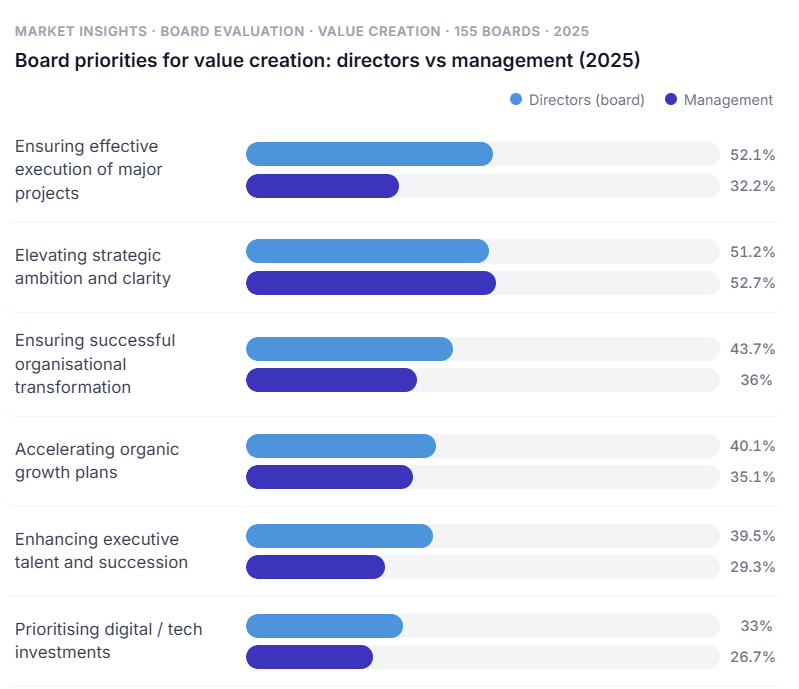
Across 155 boards in the BoardOutlook 2025 benchmark pool, approximately four in ten directors (39%) name enhancing executive talent and succession as a top priority for driving value creation over the next three to five years.
What do you believe should be the Board's top priorities to support value creation over the next 3-5 years?
Where directors and management diverge on value creation
Why this matters
Value creation is usually told as a story of strategy, capital and execution. Our data adds a quieter fourth pillar: people. When directors look three to five years ahead, they don't just see markets and margins, they see the leaders who will have to deliver them, and they are not yet convinced the pipeline is deep enough.
This is a board theme in the truest sense, because succession sits at the intersection of the board's two hardest jobs: holding management to account today, and safeguarding the organisation's continuity tomorrow. A board that gets strategy right but leadership wrong has secured nothing durable. Directors appear to understand this intuitively, which is why talent continuity climbs their priority list even as day-to-day operators stay focused on nearer-term delivery.
What it means
The gap between directors and management is a key insight, and it can be read two ways.
The constructive reading is healthy division of labour: management is close to execution, while the board lifts its eyes to the horizon and asks who will lead next. Boards are doing exactly what boards are for.
The cautionary reading is a blind spot. If directors see a leadership-continuity risk that management does not yet feel, the organisation may be under-investing in the very pipeline the board is worried about. When asked specifically about areas for improvement in talent and succession, two major gaps consistently exist. The board is more concerned about sufficient visibility to the talent pipeline (A concern for 42% of the board vs 22% of management) and sufficient candidates for CEO succession (A concern for 36% of the board versus 25% of management). When the people accountable for long-term ownership are consistently more anxious about succession than the executives running the business, that misalignment is itself a governance signal worth surfacing.
The implications for boards
- Make succession a strategy conversation, not an HR update. Directors are already treating talent as a value-creation lever. The board agenda should reflect that, with succession discussed alongside strategy rather than parked in a once-a-year committee slot.
- Close the perception gap deliberately. If the board weights leadership continuity more heavily than management does, name it. Align on where the real pipeline risks sit before they become a crisis of the moment.
- Look beyond the CEO. Directors prioritise visibility on broad executive talent (42%) well ahead of CEO succession alone (36%), a signal that depth across the top team, not just the top job, is where boards see fragility.
- Test readiness, don't assume it. A named successor is not the same as a ready one. The board's role is to pressure-test bench strength against the strategy the organisation is actually pursuing.
About BoardOutlook's benchmark insights
These findings are drawn from BoardOutlook's global benchmark pool, an aggregated and anonymised dataset built from the board evaluations organisations run on our platform. The 2025 figures here reflect 155 boards worldwide responding to a structured question on value-creation priorities, with results broken out by directors and management so the boardroom view can be compared with the executive view. Because the data is pooled across the market rather than tied to any single organisation, it offers a rare, like-for-like read on what boards everywhere are actually prioritising, not what they say in public, but how they assess themselves in confidential evaluation.