
Boards that evaluate their performance repeatedly tend to get better.
That is the clearest finding from our analysis of 50 boards that completed repeat Board Effectiveness Reviews with BoardOutlook over multiple years, covering 528 individual board-section comparisons across multiple evaluation cycles.
Boards that completed three evaluations during the period improved their overall positivity scores by an average of 3.6 percentage points. Boards that completed two improved by 0.7 points.
Some important caveats upfront: This data does not prove or imply that evaluation caused the improvement. Boards starting from a lower base tended to improve more, so some of the uplift will be regression to the mean. Board populations are also small, usually 12 to 15 respondents, which means individual board movements can be noisy.
But across 50 boards, the pattern is still worth paying attention to.
The real value of a board effectiveness review may not be the diagnosis itself. It may be what happens next. The first review tells a board something about itself. The next one tells it whether anything actually changed.
The real value is in the cycle
Boards are fundamentally hard places to improve.
Directors are dealing with strategy, risk, performance, succession, stakeholders and management, often in a limited number of meetings each year. They are expected to challenge without derailing, support without becoming captive, and make good decisions with incomplete information. The work is demanding, and the problems do not arrive one at a time.
In that environment, it is easy for good intentions to disappear into the machinery of the board.
A board can agree that papers need to improve, that meetings should be sharper, that succession deserves more attention or that directors need to engage differently with stakeholders. Reaching those conclusions is rarely the difficult part. The difficult part is turning them into behaviour that is different enough, and consistent enough, to show up a year later.
That is why repeat feedback matters. Boards do not have many natural feedback loops. Executive teams operate every day and are constantly tested by customers, employees, competitors and financial results. Boards meet intermittently. Feedback is slower, softer and often less direct.
A weakness can survive for quite a long time without anyone really knowing whether it has improved. Repeat evaluation creates that test.
The easiest things to change are usually owned by one person
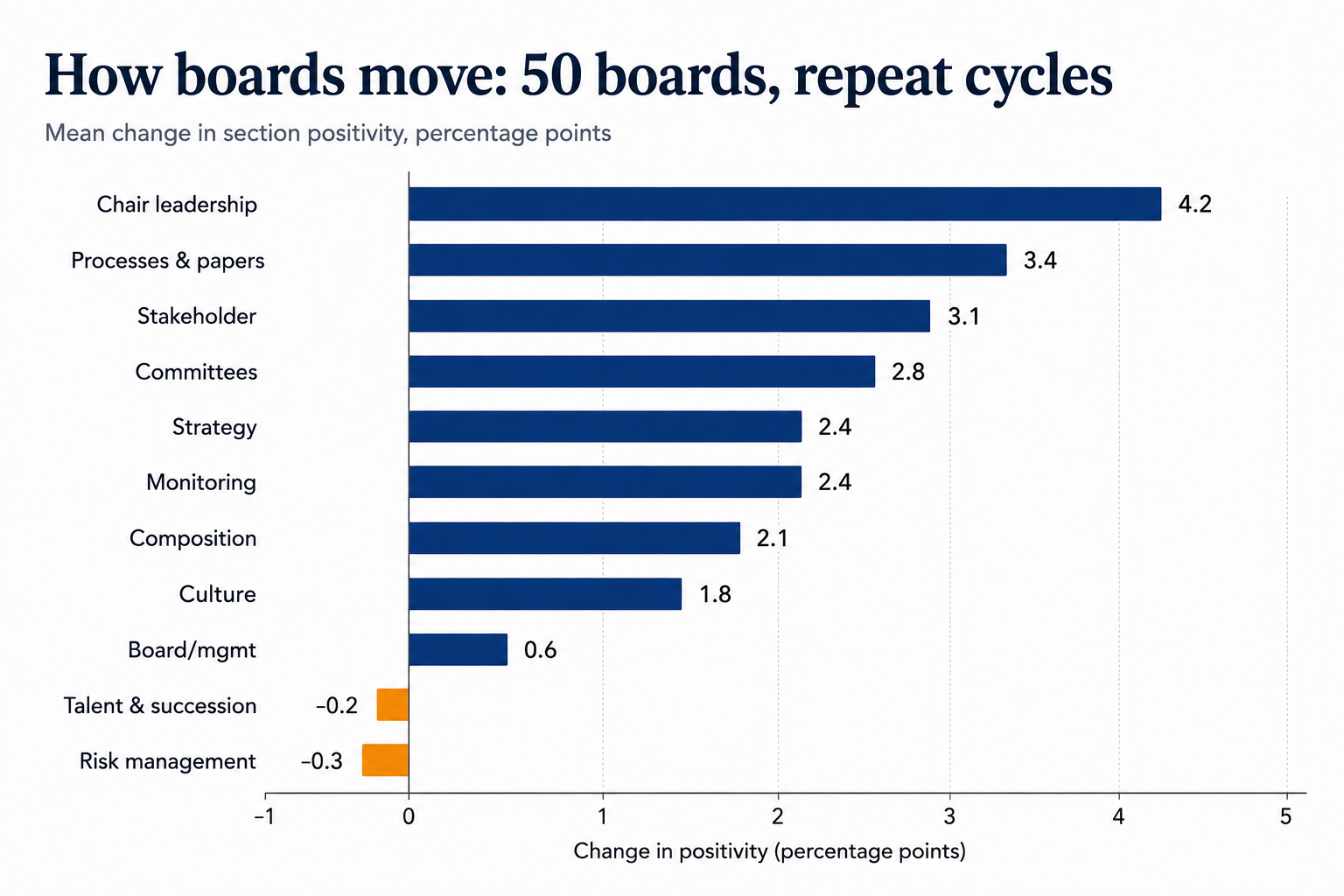
The areas that improved most in our data were Chair leadership, Board processes and papers, and Stakeholder management.
Chair leadership improved by 4.2 percentage points. Board processes and papers improved by 3.4 points. Stakeholder management improved by 3.1 points.
What these areas have in common is not that they are simple or unimportant. It is that responsibility for changing them can often be concentrated.
A chair can change how they run a meeting. They can create more room for challenge, sharpen the agenda, draw quieter directors into the discussion or change how decisions are framed. A strong company secretary can materially improve the quality and structure of board papers. A chair and CEO can clarify how stakeholder engagement should work.
When the problem is clear and one person, or a very small number of people, has the authority to act, things can move relatively quickly.
That is not because the work is easy. It is because the ownership is clear.
The hardest problems belong to everyone
The areas that moved least tell a different story.
Talent, succession and remuneration remained effectively flat, and was the lowest-rated area in the dataset by a wide margin. Risk management was also flat, although from a healthier base.
These are harder problems because no single person really owns them.
A chair cannot fix succession alone. Neither can the CEO. Strong succession requires a management pipeline, clarity about future capability, visibility of internal talent, alignment across the board and management, and decisions made well before they become urgent.
Risk has much the same quality. It depends on management systems, information flows, committee structures, board capability and the behaviour of the whole board.
These are not problems that improve because one person decides to do something differently.
They require the system to move.
That is where things get difficult. Once ownership is distributed across a group, everyone can agree that an issue matters while still being slightly unclear about what they personally need to do differently. Actions become broad. Responsibility blurs. Progress becomes hard to see.
And for directors, that can be deeply frustrating. The board may be having the right conversations and taking the issue seriously, yet still find itself looking at the same problem twelve months later.
That does not necessarily mean the board has failed to care. It may mean the problem was never translated into a sufficiently good plan.
Hard problems require better plans
“Improve succession planning” is not a plan.
Neither is “strengthen risk oversight”.
They are statements of intent.
If a board genuinely wants to move one of these harder areas, it needs much more precision. What exactly is going to change? Who owns each part? What does management need to do differently? What does the board itself need to do differently? What decisions need to be made, and by when? How will the board know if it is actually making progress?
The harder the problem, the better the plan needs to be.
This is where many board performance processes lose momentum. The review identifies the right issue. The board has the right discussion. Everyone agrees it matters. Twelve months later, the issue is still there.
For complex problems, the response needs to be more substantial. Succession might require a multi-year view of executive capability, named internal successors, agreed development gaps and clearer exposure of candidates to the board. Risk might require different information, clearer committee roles or a different rhythm for discussing emerging threats.
The diagnosis matters. But on the hardest issues, a comprehensive execution plan is what moves the score.
Boards do not stay good by accident
Perhaps the broadest point here is that boards are never static. Strategy changes. CEOs change. Directors change. Risks change. Organisations grow. Markets move. What worked three years ago may no longer be enough.
That makes reflection and adaptation part of the job.
A history of governance crises shows that a board can be strong and still need to change. In fact, one of the risks of being strong for a long time is becoming less curious about whether the things that made the board effective are still serving it. That is why trajectory matters.
A board sitting comfortably at a respectable level but changing very little may be less impressive than one that starts with obvious weaknesses, confronts them and improves over several cycles.
Our data does not show that running more evaluations magically produces better boards. That would be a very convenient conclusion for us, and a fairly silly one.
What it does show is that boards which keep evaluating tend to improve, and that the things which move fastest are usually those with clear ownership. The things that remain stuck are more likely to require systems, shared accountability and coordinated effort across the board and management.
For directors, that distinction matters. Some problems need one person to act.
Others need the whole board to change how it works.
And those are the problems that demand more than goodwill. They demand a very good plan, and the discipline to come back later and ask whether it worked.