

A board evaluation is an exercise every board should conduct at least once a year. Not only does it hold the board of directors accountable for their performance, it identifies challenges and opportunities, allowing the board to evaluate what is working well and what could be improved.
Board evaluations are commonplace for organisations of all sizes and complexities. By periodically evaluating performance, the board has an opportunity to reflect on its strengths and celebrate those successes, while also understanding any areas for improvement, leading to enhanced performance in the long-term. This is valuable not only for the board of directors, but for the company as a whole and its stakeholders.
In this article, we’ll cover the different types of boards that should conduct a board evaluation, as well as best practices and ideal outcomes when measuring board performance.
What is a board evaluation?
The role of the board is usually centred around oversight on strategic direction, risk management and monitoring of the executive team. A board evaluation is a critical process that examines these roles, assessing how effectively they are being fulfilled.
There are several different terms for the process, with the three most common being board evaluation, board performance review and board effectiveness review. Whichever term is used, the process is by and large the same – and is an essential piece in determining whether the board is carrying out its roles and responsibilities effectively.
A board evaluation is:
- also referred to as a board performance review or board effectiveness review
- an essential piece in determining whether the board is effectively carrying out its roles and responsibilities
- Helpful in identifying alignment between the board and management and deepening the relationship

What types of boards should conduct a board evaluation?
In many countries, there are regulatory requirements to conduct a board evaluation. What types of businesses are governed by these requirements depends on the size and complexity of the business, including whether they are publicly listed and what industry they operate in.
Outside of regulatory requirements, board evaluations can be an effective way to assess the performance of the board. Boards that wish to conduct a board review should consider the following questions:
- What are the obvious problems in the way the board is working now (if any)?
- What are stakeholders and management saying?
- Does the board have a budget to conduct a review process?
- Have there been any recent changes in the board’s structure (e.g. new Chair) and feedback would be valuable to performance?
Different ways to measure board effectiveness
The board evaluation process can be conducted in any number of ways. In some parts of the market the board is required to engage an external board evaluation consultant to facilitate the process. Depending on the complexity of the business, this can be undertaken on an as-needed basis, although typically it is once every three years.
Whether conducted internally or externally, the methodology broadly remains the same, with both qualitative and quantitative data being collected to inform the board on their performance. Below we’ll cover the key differences between different methods for conducting a board evaluation.
Internally-led board evaluations
Depending on the business, an internal evaluation is typically led by either the Company Secretary or the Remuneration & Nomination Committee. This process will usually involve a survey before the data is reviewed and discussed.
Benefits
- The board owns the process and can focus on specific goals
- May be a suitable option for organisations with little to no budget
- Ensures directors are regularly reminded of their roles and responsibilities
Considerations
- Limited to no external benchmarking or sense of best practice within the sector
- Can take weeks, if not months, for information to be collected, reviewed and presented
- Directors may lack confidence in how rigorous the process is. Will it be able to uncover all key perspectives? Will all views be presented in a fair and equitable manner?
- Little visibility on how and where the board evaluation data is being stored, which can affect the nature of feedback given by participants
Externally-led board evaluations
When an external consultant is engaged, they will typically work closely with the Company Secretary and Chair to evaluate the board’s performance. This process usually involves a questionnaire sent out to directors and the executive team, and will also likely involve interviews for further clarity, as well as a review of board meetings, board papers and other board documents.
Benefits
- If the board has not seen significant change in composition, a new perspective can be valuable
- The board can demonstrate best practice and provide stakeholders with greater assurance of rigorous governance processes
- Can help to deepen trust and enhance the relationship with the executive team
- Ensures full coverage across all key areas of board performance
- Peer benchmarking to help inform decisions and key areas of focus
- Meaningful feedback to drive director development
- Support on the board’s toughest challenges
Considerations
- Selecting the right consultant is dependent on identifying the board’s requirements, specific areas of focus and understanding what success will look like. The scope of work must be a good fit with the experience and expertise of the consultant for meaningful outcomes to be achieved.
- What steps are taken to protect the confidentiality of individual director responses? Confidentiality is paramount as it can have an impact on the board’s relationship with the consultant and ultimately the effectiveness of the process.
- The time requirement involved by directors, management and the chair. Scheduling in-person interviews can be challenging and time consuming to undertake.
- Is the personality of the consultant leading the process a good fit for the board and will they listen and respect the recommendations provided?
- Is the consultant experienced enough in governance, board processes, culture and director duties?
Best practice for board evaluation
The board of directors has a duty to act in the best interests of their stakeholders, working as effectively as possible towards the company’s stated objectives. Whether the board is looking to run an internally-led evaluation or engage an external expert, there are some best practices to consider before beginning the board review process.
Making sure questions are relevant to the organisation
A good board evaluation ensures that the questions asked to measure effectiveness are relevant to the board answering them. This doesn’t necessarily have to be completely custom questions, but it’s useful to make use of research-supported questions that have been tested for efficacy by other similar organisations. This is something the board evaluation module at BoardOutlook offers for boards that take advantage of the platform.
Finding a balance between qualitative and quantitative feedback
Qualitative feedback can offer valuable insights for the board in relation to its performance, however it can also prove time-consuming and difficult to quickly identify key areas of focus. By including quantitative data, the board can benchmark against other similar entities, uncovering any areas that the board may be finding more or less challenging than peers. Quantitative data also enables the board to test alignment with management and can make tracking progress over time a far simpler process.
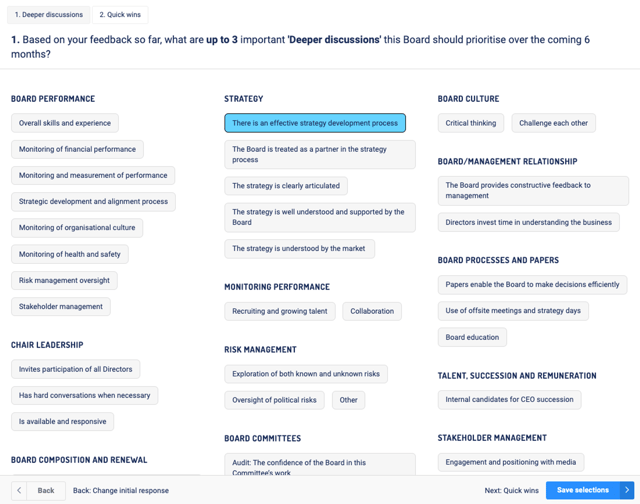
Incorporating prioritisation frameworks
In some situations, a board evaluation may identify multiple areas that need work. While this is important for the board to identify, not everything can always be addressed at once. That’s why incorporating a prioritisation framework within the board evaluation process is another critical piece to the puzzle. This will ensure when it’s time to take action, the board can focus on quick wins or core challenges the majority have agreed upon. Providing a sense of momentum coming out of a board review process is one of the best ways to ensure engagement and meaningful action is taken to improve performance.
Ideal outcomes from a board evaluation
Once a board evaluation is completed, the end goal is to have a clear picture of what the board is doing well and should be optimised, and what, if anything, needs to be improved upon. This is why it’s critical that the data generated from the evaluation is able to be distilled in a way that actionable insights can be generated.
Without the ability to take action, meaningful performance enhancements cannot be made, making the whole process more of a box-ticking exercise than a performance enhancement process.
In a lot of cases, the best way to support this is by utilising a platform like BoardOutlook – taking advantage of the frameworks that have been developed and tested on hundreds of other organisations. From there, the board can identify what needs to be on its action plan, and if required, can engage an external party to support this process.
Building a culture of continuous improvement
When well run, board evaluations help boards perform better. It’s more than filling out the same questionnaire each year to fulfil governance and regulatory requirements. Board performance is about building a culture of continuous improvement, while also pausing to celebrate wins when the board is functioning well.
When it comes to completing a board evaluation process on the BoardOutlook platform, our aim is to ensure boards are provided with data-driven insights to inform decision-making and enhance performance over the long term.
Related articles